
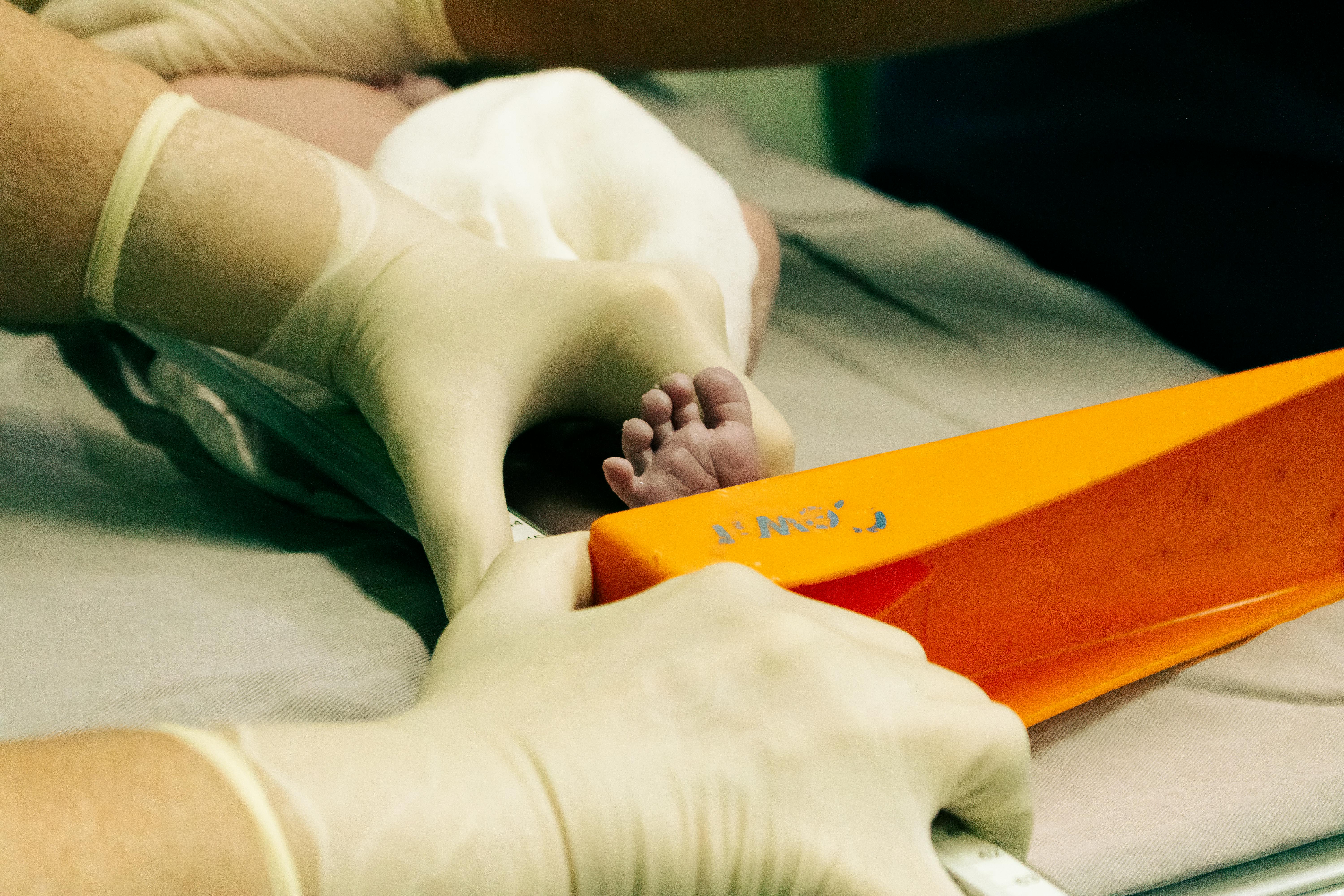
Temperature management is one of the first practical concerns after birth. A newborn loses heat considerably faster than an adult and has fewer ways of generating it back.
Surface area to mass works against them
Heat is lost across a surface and generated by a volume. A small body has proportionally much more surface relative to its mass than a large one.
A newborn therefore radiates heat over a relatively large area while producing it from a small reserve. The imbalance is geometric and cannot be trained away.
The head accounts for a large fraction of that surface in a newborn, which is the reasoning behind covering it in the period immediately after birth.
Insulation is thin at birth
Subcutaneous fat provides most of the body's insulation, and a newborn has comparatively little of it. Preterm babies have less again, which is why they are managed more actively.
Skin is also thin and permeable, so water evaporating from the surface carries heat away. A wet newborn cools far faster than a dry one at the same room temperature.
Drying immediately after birth addresses the largest single route of loss. It matters more in that moment than the temperature of the room does.
Shivering is not available yet
Adults generate heat by shivering, which uses muscle activity to raise output. Newborns do this poorly and rely on a different mechanism instead.
Brown adipose tissue, laid down late in pregnancy, produces heat directly rather than through movement. It is present around the back, neck and shoulders.
The supply is finite and is consumed when used. A baby who is repeatedly cooled expends energy on warming that would otherwise support growth.
The four routes of loss are handled differently
- Evaporation from wet skin, addressed by drying
- Conduction into a cold surface, addressed by warmed bedding and skin contact
- Convection from moving air, addressed by avoiding draughts
- Radiation to cold surrounding surfaces, which continues even in a warm room with cold windows
Radiation is the one most often missed, because the air temperature can be correct while the surrounding surfaces are not.
Skin-to-skin contact addresses several of these simultaneously, which is part of why it is standard practice in the period after birth.
Overheating is the other side of the same problem
The same limited regulation means newborns also struggle to shed heat. Excess wrapping, warm rooms and car seats in sunlight all carry the opposite risk.
Guidance on room temperature and bedding exists because both directions matter, and overheating is associated with its own risks during sleep.
A newborn who feels cold or unusually hot to the touch, or who is difficult to rouse or feeding poorly, should be assessed by a health professional rather than simply rewrapped.