
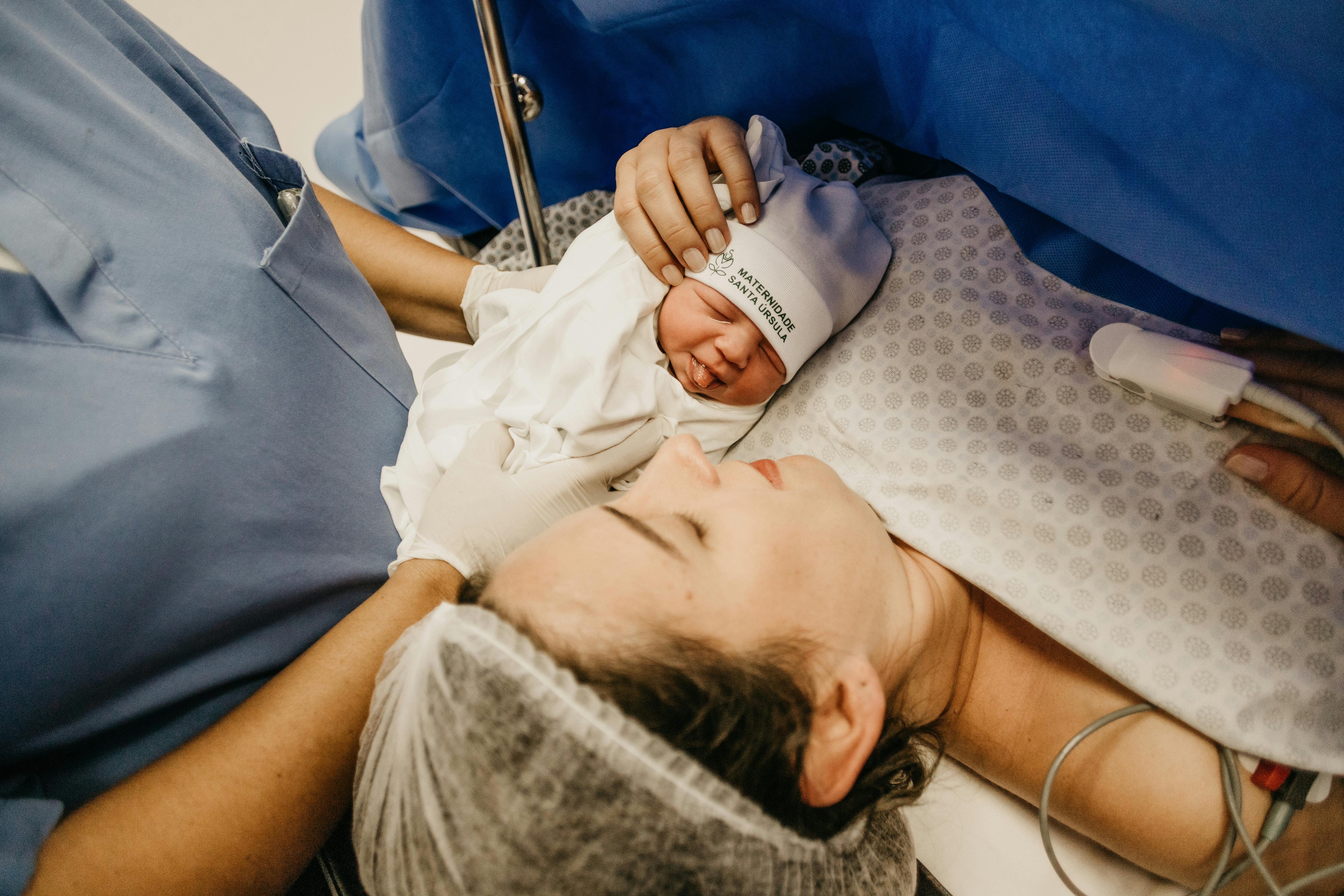
Newborns arrive with a set of automatic movements that are absent in adults. Their appearance is expected and so is their disappearance, and clinicians watch both.
These are patterns run below conscious control
Primitive reflexes are organised by the brainstem and spinal cord rather than by the cortex, which is why they are present before voluntary movement develops.
They fire in response to specific triggers and run to completion without variation. A reflex looks purposeful but involves no decision at any point.
Because they depend on intact pathways, their presence at birth indicates that those pathways are functioning. This is what makes them useful to examine.
Several have obvious functions
The rooting reflex turns the head toward a touch on the cheek, and the sucking reflex follows contact with the palate. Together they make feeding possible without any learning.
The grasp reflex closes the fingers around anything pressed into the palm, with a corresponding version in the toes. Its function in humans is debated but the pattern is consistent.
The startle response, triggered by a sudden loss of support or a loud sound, produces a symmetrical outward fling of the arms followed by a drawing in.
Disappearance signals cortical development
As the cortex matures it exerts increasing control over lower structures, and one effect is the suppression of these automatic patterns.
Reflexes therefore fade in a fairly predictable order across the first months. The grasp gives way to deliberate reaching, and rooting fades as feeding becomes voluntary.
Persistence well beyond the usual window can indicate that this maturation is not proceeding as expected, which is why clinicians note the timing rather than only the presence.
Some reflexes support later movement
The stepping reflex produces walking-like leg movements when a newborn is held upright with feet touching a surface. It disappears within months and reappears as voluntary walking much later.
Asymmetric neck reflexes turn the head and extend the arm on the same side, which brings a hand into the visual field. This may support the development of hand-eye coordination.
The relationship between early reflexes and later voluntary skills is not a simple continuation. The later skill is built by the cortex rather than inherited from the reflex.
What the examination is looking for
A newborn examination checks that reflexes are present, symmetrical and of appropriate strength. Asymmetry is often more informative than absence, since it can point to a localised problem.
Findings are interpreted alongside tone, alertness and feeding rather than in isolation. No single reflex carries much weight on its own.
Parents observing a movement pattern that seems one-sided, or a baby who seems unusually floppy or stiff, should raise it with a health professional. Reflex assessment is a clinical task rather than a home one.